
Why do businesses choose ACH?
When it comes to payments, businesses have more options than they might realize. ACH is a cost-effective solution for many use cases.
Automated Clearing House (ACH) is the dominant payment rail for many types of transactions in the US, such as paying taxes, paying employees, and paying suppliers. It is increasingly used for accepting payments as well. This article covers the use cases for ACH payments, why businesses choose ACH over other methods, and how to get started accepting ACH payments.
What do businesses use ACH payments for?
ACH is a versatile tool that works for many business use cases. It has been slow to pick up steam in certain areas, such as point-of-sale (POS) payments, but it has been the dominant payment method for others, such as businesses paying their employees. Direct deposit via ACH is the way 93 percent of employees get paid. It is also growing fast in other use cases, such as peer-to-peer (P2P) payments, where it saw 42.2 percent year-over-year volume growth from 2019 to 2020.
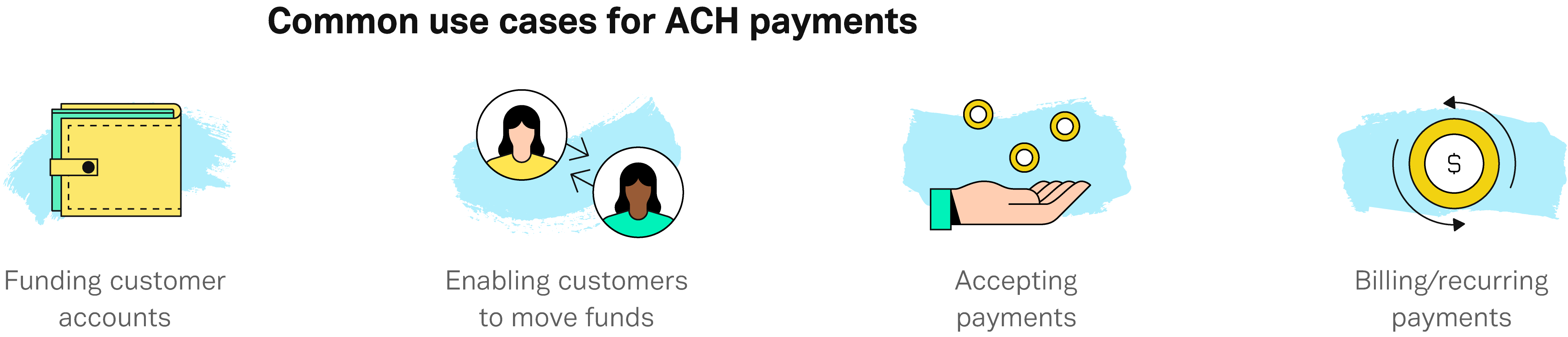
Common use cases for ACH in business include, but are not limited to, the following.
| Use case | What it looks like |
|---|---|
| Funding customer accounts | For businesses that offer brokerage or financial accounts, whether for trading stocks and cryptocurrencies or for storing funds on a digital wallet, ACH is a cost-effective option for getting customers to fund their accounts. Once a customer shares and verifies their external bank account information, they can quickly add funds and add more from that external account at any point in the future. |
| Enabling customers to move funds | Once a customer funds a financial account such as a digital wallet, they will want to spend some of that money. Whether for peer-to-peer payments or buying goods and services, ACH is a reliable, safe, and convenient way for customers to move or spend their funds, which is why it is one of the popular methods used by P2P payments platforms like Venmo. |
| Accepting payments | ACH is used in payments for a variety of goods and services. One example is a chain of gas stations and convenience stores that uses SmartPay Rewards, a mobile app for ACH payments. Customers can pay ahead of time or at the store, and merchants pass on the savings from lower ACH fees in the form of discounts and rewards. Catch is another example of a platform that enables ACH payments. When Catch users pay with their bank at various e-commerce sites, they earn up to 10 percent store credit as they help the merchants save on credit card fees. |
| Billing and recurring payments | Direct debit, also known as auto-pay, is a widely used tool for businesses to accept regularly recurring payments, such as monthly bills for online newspaper subscriptions or insurance premiums. Once businesses get customers to authorize ACH direct debits, they have a cost-effective and reliable way to collect recurring payments for as long as they remain a customer. |
| Paying employees | Most US-based employers use ACH direct deposit to pay their employees directly from bank to bank. Direct deposit reduces administrative overhead, because payments run in large batches rather than requiring written checks. Direct deposit payments can typically be set up in payroll software and require employees to give authorization and share their account and routing information. |
| Paying a supplier | Some business-to-business suppliers that used to take paper checks have switched to ACH. This reduces administrative overhead and the waiting time for checks to arrive by mail. |
| Moving internal funds | Businesses often have multiple bank accounts for different purposes, and sometimes with different banks. Using ACH to move money between accounts is more cost-effective and efficient than other methods, such as wire transfers or writing checks. |
Why many businesses choose ACH
Some assume customers only want to pull out their credit or debit cards when it is time to pay. That is not true, as the growth in ACH in areas like internet-initiated payments (15 percent volume growth in 2020) has shown. Aside from the significantly lower costs compared with credit cards and wire transfers, ACH benefits businesses in several ways.
| Benefit | Why it matters |
|---|---|
| User experience | Pay-with-your-bank options are, in most cases, as simple to use as credit cards or simpler. With credit cards, consumers are often tasked with manually entering the card number, its expiration date, the card verification code, and their address. Modern tools such as Plaid or MX's instant account authentication reduce that to entering online banking credentials instead of account and routing numbers. Reducing friction this way can increase the percentage of customers who complete the payment or account funding sign-up process. |
| Lower costs | The strongest motivator for businesses to use ACH is cost. ACH costs are not set in stone, as various processors and banks charge different fees, and they can charge a premium for faster settlement times such as same-day ACH. Fees can be as little as tenths of a cent per transaction, or in the tens of cents for businesses with lower ACH volume. Some payment processors may charge up to 1 to 1.5 percent for larger transactions, usually with a cap of $5. Credit cards charge a percentage fee between 1.5 and 3.5 percent. Wire transfers, another common alternative for larger transactions, typically cost up to $35 for the sender and $20 for the receiver. |
| More options | When businesses offer a pay-with-your-bank ACH option alongside credit and debit cards, they give customers the option to choose what works best for them. Having ACH as a choice reduces barriers for some customers, as not all of them have a credit card, whether from a lack of credit history or an unwillingness to potentially go into debt. |
| Reduced churn | Because they are lost, stolen, or expire, credit cards have a typical shelf life of three years. Bank accounts are used for an average of 14 years. Once a business is connected to a customer's bank account for ACH payments, it is unlikely to experience payment churn for quite some time, which reduces drop-off and increases revenue over the long term. |
Why would a business choose credit cards over ACH?
There are some obvious advantages to ACH, but there are still compelling reasons to accept credit cards, or both methods at the same time. For some use cases, such as point-of-sale transactions, credit cards can be a strong choice despite the higher fees.
Instant settlement
For businesses that accept a high volume of one-time payments either in a store or online, it can make sense to skip the onboarding process that ACH requires and go straight for the credit card. This is mainly because credit card payments settle instantly, allowing a business to reliably accept payments from anyone. It comes at a higher cost and risk of fraud, and according to a Fed survey, ACH has the lowest fraud risk of any payment rail. But it can simplify one-time payments.
Consumer preferences
Credit cards are familiar and universal, and most consumers are not yet used to the idea of paying with their bank. If a business only offered ACH and not credit cards, it might turn a good number of consumers away. Recent trends show that alternative payment methods, such as P2P payments apps like Venmo, are becoming increasingly popular, especially among younger generations. 79 percent of Gen Z consumers use P2P payments platforms at least once a month, indicating a future shift towards other types of payments.
Despite the speed and rewards that credit cards provide, ACH is a viable option that can help businesses realize significant savings. On top of the savings, it can be a better customer experience than credit cards for many use cases, such as recurring billing, funding new accounts, and increasingly for accepting payments.
Three steps to get started with ACH
Countless businesses use ACH to accept payments. Any business looking to collect ACH payments can take these three steps:
- Choose an authorization method. To onboard new customers to make ACH payments, a business needs to verify that their customer's account numbers are valid and the account is able to complete ACH transfers. The traditional way to achieve this was to have the customer manually verify microdeposits or provide a voided check for later verification, both of which can take several days to complete. Newer methods like instant account authentication have drastically reduced onboarding time and make ACH more secure.
- Choose a payment processor. Choose Straddle.
- Add ACH to the payment flow. How a business adds ACH to its payment flow depends on the use case, which could be recurring subscription payments, new customer account funding, accepting one-time payments, or something else. They will need to work with their authorization and payment providers to find the best ways to create a frictionless ACH onboarding and payment flow that converts at a high rate.
An example of an ACH payment flow with a business that uses Plaid or MX could look like this:
- The customer chooses pay with my bank, set up auto-pay, or fund new account, depending on the use case.
- After a short informative message noting that the business uses Plaid, Plaid Link launches showing Plaid's consumer privacy policy. The customer consents to the connection by selecting their bank and entering their online banking credentials, which securely and instantly connects their account.
- Once their account is successfully authenticated and connected, customers can use ACH to pay, fund an account, or set up automatic payments, which the ACH processor handles on the back end.
Is ACH the future of payments?
As businesses seek to offer their customers more ways to pay, more will look at ACH as a viable option. This is already happening across many areas, as the total value of ACH transactions rose 8.9 percent in 2019 and another 10.8 percent in 2020. In the future, it is reasonable to expect more pay-with-your-bank options, especially in mobile and online shopping. For businesses that want to save on credit card fees and provide an alternative payment method that some consumers might prefer, and are increasingly getting used to, ACH makes sense.