
What is an ACH debit?
When money moves out of an account for a purchase or a bill payment, it is usually an ACH debit at work.
The ACH (Automated Clearing House) network is an interbank messaging system for transactions involving US bank accounts, built in the 1970s to remove the need for paper checks. ACH is the main way that financial institutions organize the movement of money in and out of personal accounts.
Every transfer debits someone's account. What makes it an ACH debit is that the party receiving the money initiated the request, asking the network to pull funds. When the payer initiates and pushes money instead, it is an ACH credit, even though money still leaves their account.
What is an ACH debit?
Any ACH transaction structured as an ACH debit pulls money from one account and moves it to another, such as from a consumer's personal account to that of a business or government agency.
The ACH network constantly takes in batches of push and pull requests from banks and their intermediaries. Then, five times per business day, the network sorts them into new bundles and delivers them accordingly. When a given request in one of those new batches asks that an account be debited some amount of money, that is an ACH debit request.
For most consumer billing scenarios, the biller is the one initiating, or originating, the ACH request. Because that request asks the system to pull money, it is considered an ACH debit. If a consumer instead sends money as a one-off transfer from their online banking portal, they are asking the network to push money for them, which is not an ACH debit.
How does an ACH debit work?
In an ACH debit transaction, one party agrees to pay another. The party receiving payment sends a message to the ACH network asking it to collect that payment and move the funds into their account. Mechanically, an ACH debit follows these steps:
- The payee, also called the originator, or their processing partner gives an Originating Depository Financial Institution (ODFI) the payer's account information along with the amount to be debited, a categorization code, and a target settlement date.
- The ODFI, generally a bank, or the processing partner passes these requests on to the ACH network.
- Five times per business day, the ACH network breaks these incoming bundles down into individual messages, each representing a transaction, and rebundles them for delivery to each Receiving Depository Financial Institution (RDFI).
- Each RDFI imports the batch into its system, executes or queues all the transactions, and sends back any error codes with its next regular batch.
- If the ODFI receives no error or return code by the requested settlement time, the ODFI and RDFI settle the transaction using their balances at the Fed.
- The ODFI releases funds for settled transactions to the payee.
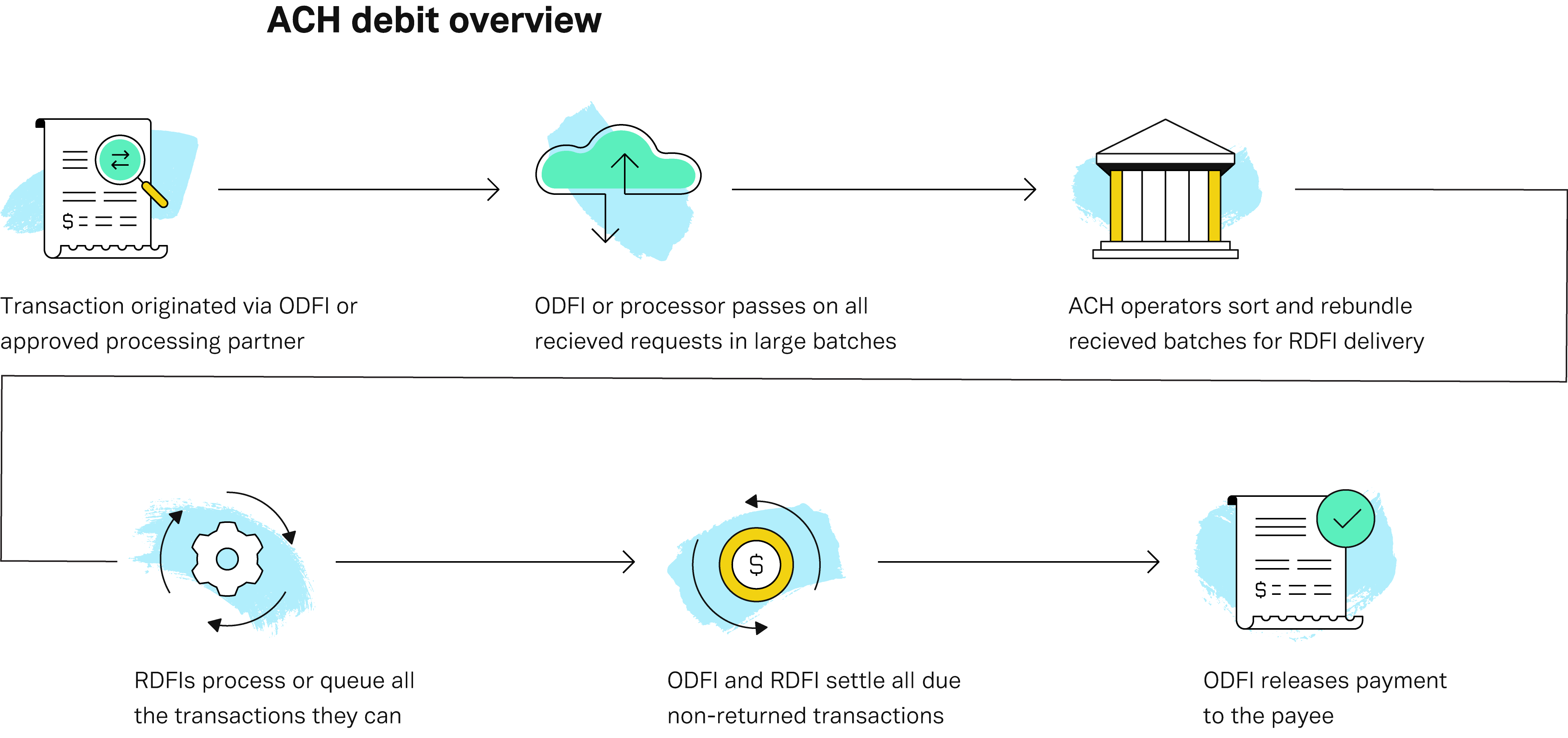
These debits can take just one business day, depending on when the first messages are sent and whether the ODFI pays for same-day processing. Some error codes require reversal, because the RDFI has two business days to inform the ODFI of certain problems. This is why ODFIs and originating processors often partner with technology companies to reduce the chances of an error or return.
For more on timelines, see How an ACH transfer works.
Main types of ACH debit
The ACH system supports different types of debit. Each is identified by its own Standard Entry Class (SEC) code representing a specific use case. These are the most common SEC codes for ACH debit.
| Code | Name | What it covers |
|---|---|---|
| ARC | Accounts Receivable Entry | Converting physical checks received by mail or drop-box into ACH debit transactions |
| BOC | Back Office Conversion | Converting physical checks received from the payer in person into ACH transactions some time after they are received |
| MTE | Machine Transfer Entry | Debiting bank accounts to settle ATM withdrawals |
| POP | Point-of-Purchase Entry | Immediately converting physical checks received in person from the payer into an ACH transaction, where the check is voided and returned |
| POS | Point-of-Sale Entry | Debiting bank accounts for card payments made through an electronic terminal |
| PPD | Prearranged Payment & Deposit Entry | Directly debiting bank accounts for pre-authorized bill payments |
| SHR | Shared Network Transaction | Electronic terminal payments for ACH-linked debit cards within a shared network |
| TEL | Telephone-Initiated Entry | Debiting bank accounts for transactions originated over the phone |
| WEB | Internet-Initiated Entry | Debiting bank accounts for transactions originated online |
Is ACH debit related to debit cards?
The ACH network can be used to settle transactions initiated by debit cards, but its design does not allow for transactions to be authorized in real time. Cases that require on-the-spot balance verification and debiting must happen by other means.
Debit cards use a separate real-time network for authorization, which ensures that funds are successfully decremented from the purchaser's account before ATMs or merchants need to hand over cash or valuable products. ACH debit transactions are then often used to move those funds from bank to bank to finalize the transaction.
There are now also non-card-based solutions that get around ACH's speed constraints. For example, users of Plaid-connected apps can choose to share their account balance information, which can confirm whether they have enough funds for an ACH debit transaction. With this information, initiators of ACH debit transactions can have higher confidence that it will clear without a non-sufficient funds issue, offering merchants similar upsides to a debit card transaction at a significantly lower cost.
How eChecks differ from ACH debit
eChecks are generally paper checks that have been manually converted into ACH debit requests. The term can also represent the idea of ACH transactions as a digital replacement for the paper check, where no physical check is ever used.
Most mobile banking apps let customers capture paper checks with their phone's camera. Those apps might then strip the relevant information and create ACH requests, or simply forward the digital scans to a traditional check-clearing facility. The words "do not convert to ACH" are written on some checks where preserving those scans is desired.
Virtually all checks are now converted electronically at some point in the processing journey. Whether they end up as ACH debit requests is up to each individual financial institution. ACH is often cheaper, but institutions require the right infrastructure to take advantage of it. In some cases they might prefer paying more to retain check images long-term for the information they contain, such as signatures and memos.
Challenges with ACH debit
The ACH system, though quite safe, was built with classic tradeoffs in mind. It is relatively slow, and the lack of real-time data transmission carries certain downsides. Businesses face three primary challenges with traditional ACH debits:
- Invalid account information, whether because of a mistaken input or a fraud attempt.
- A debit request returned due to insufficient funds.
- Fraudulent reversals of ACH debits by customers attempting to take back money paid for a good or service already received.
Solutions exist that help businesses reduce these risks in real time: instant account verification to check that account information is valid for online debits, balance checks to confirm enough funds are available, and transaction histories that let them look for patterns that could indicate fraud.
The ACH network is essentially the base option for money transfers in the US, on which other services can be layered to obtain the results and safety desired. ACH debit transactions in particular can be made substantially less risky with the help of enhanced ACH solutions, making them the rough equivalent to real-time products at significantly lower costs.